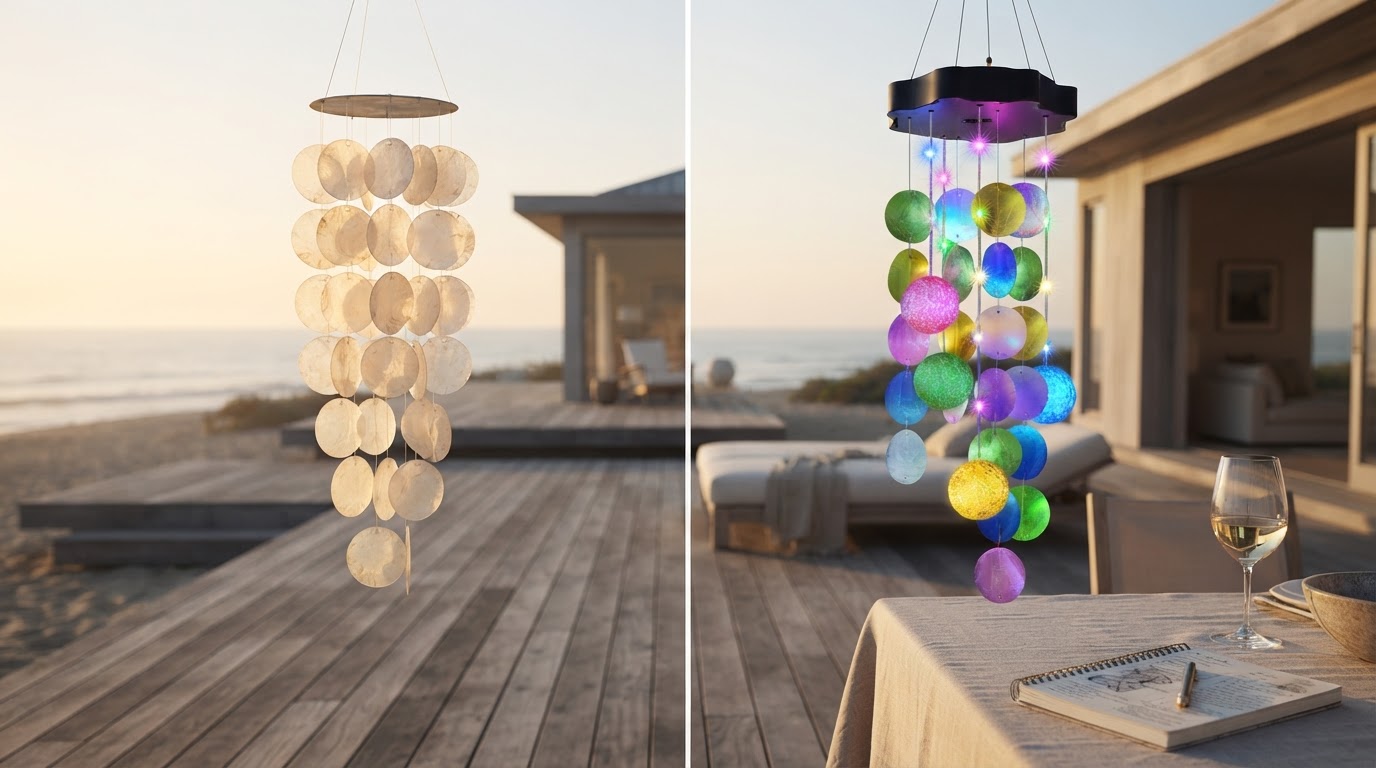
Solar Seashell Chime Performance and Durability Standards
 Maya ChenContributing Editor
September 11, 2026 — The market for coastal accents is currently saturated with decorative lighting, yet the Solar Seashell Chime remains a specific focal point for consumers seeking to bridge the gap between aesthetic wind chimes and functional solar technology.
The conventional wisdom says that outdoor solar decor is inherently disposable, lasting only a single season before the internal circuitry succumbs to salt air or moisture. However, retail data and product specifications suggest a shift toward more robust builds. For instance, the Solar Glass Shell Wind Chime at Cracker Barrel utilizes a 30.75-inch drop length to balance weight and wind resistance, signaling that physical dimensions are just as critical as battery capacity for long-term outdoor viability. While many consumers prioritize the daytime visual of iridescent shells, the engineering reality is that the solar conversion rate and housing integrity determine the actual lifespan of these units in high-humidity environments.
The Technical Performance Benchmark
Here's the part nobody talks about: the efficiency of a solar powered shell wind chime is often throttled by the very shells it seeks to illuminate. Most standard units utilize a basic polycrystalline solar panel integrated into the top housing. For a Solar Seashell Chime to maintain a consistent glow throughout the night, it requires a minimum of six to eight hours of direct sunlight to reach a full charge. The physics of the hanging arrangement matters; if the shells are too dense, they create micro-shadows that can reduce panel efficiency if the unit is not positioned perfectly vertical. When evaluating shell wind chimes solar powered for durability, the IP (Ingress Protection) rating is the only metric that truly matters for coastal placement. A rating of IP44 is the bare minimum for resisting splashes, but for true longevity near the ocean, an IP65 rating is required to prevent salt-mist corrosion of the LED leads. Run the math: a unit with a 600mAh Ni-MH battery and a standard 2V/100mA panel will provide roughly 8 hours of light, provided the discharge rate doesn't exceed 75mA. Anything less results in the flickering or dimming often misattributed to "bad bulbs" when the culprit is actually insufficient current. Choosing solar capiz shell chimes requires a trade-off between the delicate acoustic properties of thin shells and the structural weight of the solar housing. If the housing is too light, the entire assembly becomes unstable in winds exceeding 15 mph, leading to tangled lines and cracked shells regardless of the light quality. I'll change my mind when manufacturers start publishing verified wind-load ratings alongside their lumen outputs.
Expert tip: To maximize the lifespan of your solar powered shell wind chime, clean the solar collector plate monthly with a damp cloth to remove salt film, as even a thin layer of residue can reduce charging efficiency by up to 30%.
Selecting the right model involves looking past the glow to the mechanical assembly. Consumers should compare the Solar Seashell Chime against standard market offerings to ensure the hanging strings are nylon-coated rather than simple cotton, which rots in outdoor conditions. Understanding the nuances of solar capiz shell chimes can prevent premature failure in harsh environments. Proper placement of shell wind chimes solar powered units ensures they receive unobstructed light while remaining shielded from heavy gale forces. Ultimately, a solar powered shell wind chime is an electronic device first and a decoration second.
Sources
- Solar Glass Shell Wind Chime - Cracker Barrel
- MOTHERS DAY GIFT, SOLAR POWERED SEASHELL ... - TikTok
- Solar Starfish Wind Chimes for Outside Mobile Shells Wind ... - eBay